
A bunch of stories over 60 kilometres
It seems like an insurmountable stretch – 60 kilometres on the water! But if you spread it out over four days, you’ll find it’s easily manageable. And there is still plenty of time to get to know the most interesting stories that happened around the river. Between Zvíkovec and Zadní Třebáň you will collect them like Pokemons. And maybe some of the stories you hear will inspire you to have your own adventure in the river valley connecting two protected landscape areas.

Book your boat in advance with one of the many rental shops that operate on the Berounka. Pack your tent, sleeping bag, water shoes and implement boating navigation on your phone so you won’t be surprised by any weir. You can check the passability here. Just don’t be scared of the red traffic lights. The Berounka River is one of the year-round navigable rivers in almost all water conditions. It’s just gonna get a little scrubby sometimes. Clear your ears, it’s time to go for the first stories.
DAY 1: Discover the first stories in the region of Ota Pavel
Between Zvíkovec and Roztoky u Křivoklát lies the region of writer Ota Pavel. But before you get to the places where little Otik used to catch fish, you will be told the story of a Czech. Specifically, the Czech Václav Čech. A native of Šlovice, who founded one of the first small hydroelectric power plants in Czechoslovakia on the banks of the Berounka River. It began supplying the surrounding area with alternating current as early as 1917 and has been lighting people’s light bulbs ever since. And this Czech was very closely related to our second president, Edvard Beneš. Both his grandfathers came from Šlovice.
Prague’s Barrandov may have been made famous by its film studios, but did you know that this urban elevation was named after the palaeontologist Joachim Barrande? This little Frenchman made history by discovering fossils of trilobites and other paleozoic animals, even in the vicinity of today’s Skryje. Well, Skryje, which has the Barrande Museum in the centre, is your next stop in the story.

Behind Skryje, the boat still landed below the royal castle of Týřov, where the future king Přemysl Otakar II was imprisoned by his father. Just find the mouth of the Úpořský potok brook, where the ‘Purple Hermit’ from Ota Pavel’s work of the same name lived. Did you notice how we subtly got to this Jewish writer? From here to the end of the first day, which is the camp site in Višňová near Roztoky, you will cruise through the deep valley where Ota Pavel left his footprints (both live and on film). Are you sitting down? If you don’t, you better sit down right now. The following list of places will break your knees a bit.
We start with the Kouřimec fishery below Čertova skála (it also has its own story), the former dwelling of the ferryman Prošek before he moved further downstream. Does the log cabin look familiar? Of course! After all, the film versions of both of Pavel’s books were filmed here. Leave the boat at the mouth of the Tyterský potok brook behind the fishery and go for a beer at the U Rozvědčíka pub. The hangout was owned by an intelligence officer, Jaroslav Franěk, then under the name V Annamu. During the Second World War he hid weapons of the anti-Nazi resistance in beer barrels here. Franěk came from nearby Nezabudice, where he has his memorial hall. And let us not forget Luh pod Branovem with the Ota Pavel Memorial Hall in the house of the ferryman Karel Prošek. This is the place where little Otik came for holidays with his whole family. The two banks of the river are still connected by a ferry. What romance!
DAY 2: Use the shorter section for an afternoon rest
There is a place that has witnessed so many stories and hilarious tales from the shoot that it would make a book the size of a complete encyclopaedia. We are talking about the royal castle of Křivoklát, which you can reach on foot from Roztoky in just 2 kilometres. What about the stories? For example, the alchemist Edward Kelley was imprisoned here, Charles IV served his house arrest here, Filipina Welser gave birth to her own four children here in secret and then adopted them, and so we could go on forever. Modern history brought other stories, because Křivoklát = a great film star. Thanks to the silver screen, the whole world knows him. He’s still missing that star on the Walk of Fame.
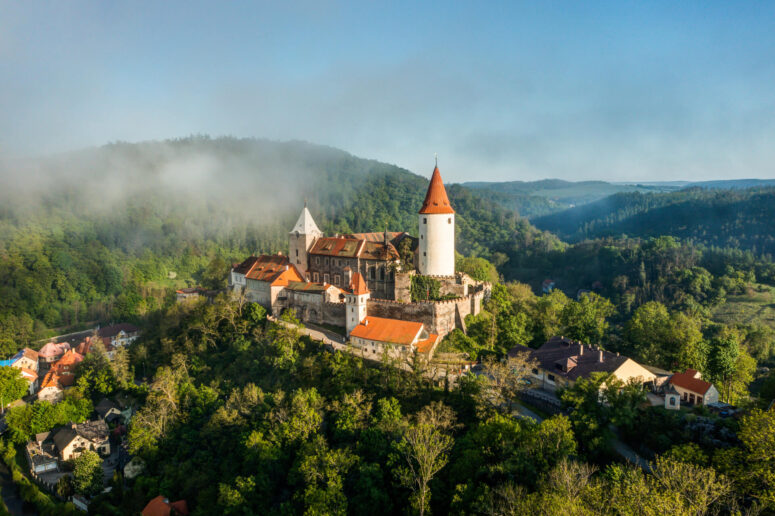
The second section is about 12 kilometres long, no hardship, but not much room for stories either. So, one more before you reach the camp in Račice, where you will lay your head for the night. In Zbečná, there used to be a wooden steading, which preceded Křivoklát. He’s long since buried deep in the ground. But there is a reason to stop here after all. Hamous’ farm is a farm. The log homestead built here at the same time as the corsair Francis Drake became the second person to circumnavigate the globe. The farmer bakes honest bread every summer Saturday, and goats and sheep graze in the yard. It’s only a short walk to Račice from Roztoky, so why not use the rest of the day for a summer swim by the lake or to hang out with local tramps and cottagers.
DAY 3: Take the award for the Best Actor
It’s time to leave. There was enough rest. The third section ends in the royal town of Beroun. This alone suggests that there will be no shortage of stories during this boat trip. But let’s not get ahead of ourselves.
After Račice, the first to speak is Nizbor. The dominant feature of the village, situated on both sides of the river, is the Baroque château. It was owned, like Křivoklát, by the Fürstenberg family. Just a short distance from the château, in a bend, is the tomb of one branch of this German noble family. Today, the château has an exhibition about the Celts who inhabited nearby Stradonice hill in prehistoric times. A stork story awaits you below the château. This leggy bird is the emblem of the Rückl glassworks, which produces the Czech Lion crystal statuettes. Next to the glassworks, a bus stop was built next to the railway station. Actor Tomáš Hanák has been rescuing unwanted train carriages for several years, from which he built the Zastávka restaurant with stylish accommodation. And so we could go on and on.

However, there is no time to waste, so for the next story, pop over to Hýskov. This is the place where František Nepil, a writer and folk storyteller with a velvet voice, was born. You can drop a peep into his family home at the end of the village.
Finally, let’s jump to Beroun. A town made famous by the little fairy-tale bears and the best ceramics in Central Europe. For bumblebees, head to the City Mountain, for clay to the Museum of Ceramics or to the Pottery Market. The list of stories here would be endless. That’s why we’re ending for today and leaving some of the exploring up to you.
DAY 4: Don’t let people to pull your leg, the final story may not be true
And the last day is here, and with it the last stories and human destinies. The first place to start is Tetín, which appears high above your head just outside the town. It all started when Teta, Krok’s daughter and her sister Libuše, settled here. At least that’s what Jirásek (Czech writer) tells us since time immemorial in his Old Czech Legends. After her, Princess Ludmila, the grandmother of St. Wenceslas, who was strangled to death with a scarf by assassins hired by her own daughter-in-law.

After Tetín, the wall of the Alkazar quarry peeks out to your left. It got its name from the tramps who were inspired by the Arab impregnable fortresses in Spain. Well, this quarry’s almost impregnable as well. When World War II ended mining here, the quarry found a new mission in the form of a Nazi underground factory for the production of aircraft engines. However, the construction of the factory took longer than Hitler planned to wage war, so the corridor system was eventually used during the ‘Mosquitoes’ to store radioactive waste from the Jáchymov mines. Leave the dosimeter at home. The corridors are covered with concrete dams, and the outer wall of the quarry became the first climbing park in the Czech Republic.
One of the biggest fake stories of Czech history is connected with the royal castle Karlštejn. They say that in the time of Charles IV, women were not allowed in it. Puh, without them the castle would have burned to the ground, drowned in rubbish and become so dingy that no one would ever see it again. You can’t believe every story. It’s just Vrchlický who pulls people’s legs. Yet this majestic castle has a story to tell. And if only one! The guides will be happy to tell you all of them. From Karlštejn it’s only a few kilometres to the destination of this water holiday. Destination: Camping Ostrov in Zadní Třebáň.


